
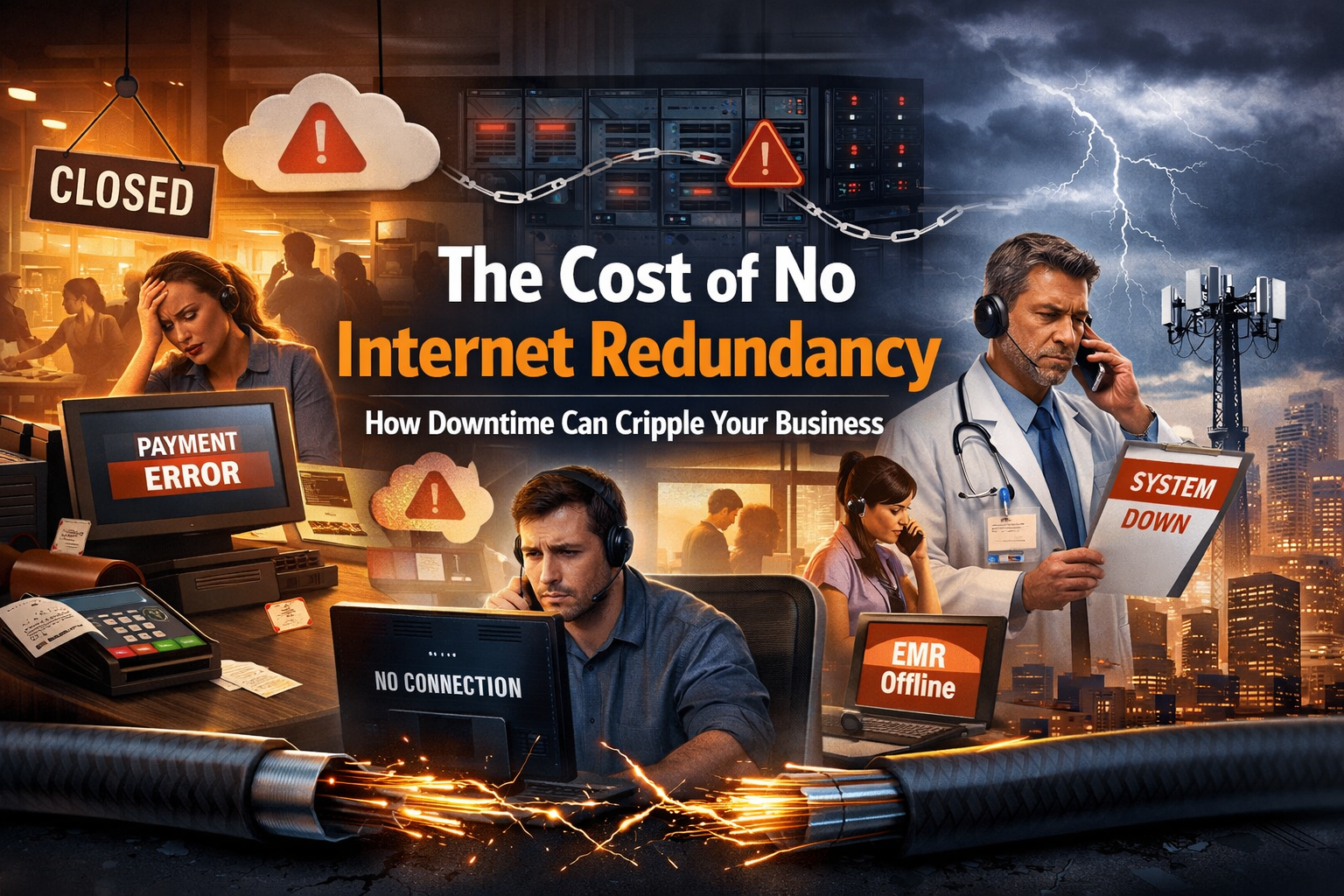
In today’s digital-first economy, internet connectivity is no longer a convenience it’s the backbone of business operations. From cloud-based software and VoIP phones to payment systems and customer support platforms, nearly every core function depends on a stable connection. Yet many businesses still operate with a single internet line, assuming outages are rare or short-lived.
That assumption can be costly.
When internet issues strike and no redundancy solution is in place, the impact ripples across operations, revenue, customer trust, and employee productivity. Let’s explore why internet redundancy matters, what happens when it’s missing, and real-world examples that show just how fragile “always-on” connectivity can be.
The Hidden Cost of Internet Downtime
Internet outages don’t always make headlines, but their effects are immediate and measurable. Even a brief disruption can cause:
- Inability to process payments
- Lost access to cloud applications (CRM, ERP, accounting software)
- VoIP phone systems going offline
- Remote employees being completely disconnected
- Missed customer orders and service requests
For many organizations, especially small and mid-sized businesses, downtime translates directly into lost revenue. Studies consistently estimate that downtime can cost anywhere from hundreds to thousands of dollars per hour, depending on the industry.
What’s often overlooked is that downtime also erodes confidence—both internally and externally.
Real Examples of Internet-Related Disruptions
1. Retail Businesses and Payment System Failures
In multiple high-profile cases, major retailers like Target and Costco have experienced internet-related outages that prevented credit and debit card transactions at checkout. While large enterprises can absorb short-term losses, smaller retailers may have no backup process at all.
Without internet access:
- POS systems stop functioning
- Customers abandon purchases
- Staff resort to manual workarounds or turn customers away
For a local business, even a few hours of this can mean the difference between a profitable and an unprofitable day.
2. Cloud Outages and Remote Work Paralysis
When major cloud providers like AWS, Microsoft Azure, or Google Cloud experience outages, businesses around the world feel the effects instantly. In one widely reported AWS outage, companies lost access to internal tools, customer-facing websites, and collaboration platforms for hours.
For businesses without redundant connectivity:
- Employees couldn’t access cloud-hosted desktops
- Customer support teams were locked out of ticketing systems
- Sales teams lost access to CRM data mid-deal
Even though the cloud provider was the root cause, businesses with secondary internet paths or failover solutions were far better positioned to adapt—rerouting traffic or switching networks while others were completely stalled.
3. Healthcare and Professional Services Risks
Healthcare clinics, legal firms, and accounting practices increasingly rely on internet-based systems for scheduling, records, and compliance. In documented cases of regional ISP outages, medical practices were unable to:
- Access patient records
- Submit insurance claims
- Communicate with pharmacies or labs
Without redundancy, these organizations faced not just financial losses, but compliance and reputational risks as well.
Why Single-Connection Setups Are So Risky
Many businesses rely on one ISP, one modem, and one physical connection. This creates a single point of failure. Common causes of outages include:
- Construction-related fiber cuts
- ISP network failures
- Equipment failure (routers, firewalls, modems)
- Weather-related damage
- Local power issues affecting network infrastructure
Even the most reliable ISP cannot guarantee 100% uptime. When that single connection fails, everything stops.
What Internet Redundancy Actually Means
Internet redundancy isn’t just “having better internet.” It means having multiple, independent paths to connectivity so that if one fails, another takes over automatically or with minimal intervention.
Common redundancy solutions include:
- A secondary ISP from a different provider
- Fiber paired with cable, DSL, or fixed wireless
- Cellular (4G/5G) failover for critical systems
- SD-WAN solutions that dynamically route traffic
The key is diversity. Two connections from the same provider, running through the same physical path, don’t truly reduce risk.
The Competitive Advantage of Being Prepared
Businesses that invest in redundancy don’t just avoid downtime—they gain resilience. When competitors go offline, resilient organizations continue operating, serving customers, and closing deals.
The benefits include:
- Business continuity during outages
- Higher employee productivity
- Improved customer trust and reliability
- Reduced stress during incidents
- Better disaster recovery posture
In some industries, redundancy is no longer optional it’s becoming a baseline expectation.
Final Thoughts: Downtime Is Inevitable, Failure Is Not
Internet outages will happen. That’s a reality of modern infrastructure. What determines the impact on your business is not if an outage occurs, but how prepared you are when it does.
Organizations that rely on a single internet connection are gambling with their operations. At IT Pro Solutions, we offer a free expert IT site survey to help businesses gain clear visibility into their connectivity risks and define a practical path toward stronger, more resilient internet infrastructure.
In a world where being offline even briefly can halt your business, redundancy isn’t an extra cost. It’s an insurance policy for continuity.